


Lil Wayne Net Worth 2026: How He Built $170 Million
TL;DR:
- Lil Wayne’s net worth is around 170 million dollars, mainly from catalog sales, royalties, and business deals. His 2020 sale of the Young Money catalog to Universal Music Group for over 100 million dollars significantly increased his wealth. His fortune emphasizes ownership, diversification, and legal control of assets in building lasting wealth.

Lil Wayne’s net worth is estimated at approximately $170 million, making him one of the wealthiest artists in hip-hop history. Forbes places his fortune at that figure as of early 2026, with musician earnings listed at $27 million. That number reflects decades of album sales, touring, royalties, and a landmark $100 million catalog sale to Universal Music Group. Understanding his financial status means looking past the music and into the business moves that turned a New Orleans rapper into a genuine industry power.
What makes up Lil Wayne’s net worth: music, tours, and royalties
Lil Wayne’s income comes from multiple directions, and no single source tells the full story. Album sales, streaming royalties, live performances, and brand deals all feed into his overall earnings. His career spans more than two decades, which means royalty checks keep arriving long after the original work was released.
His touring income alone has been substantial. Wayne has headlined major festivals and sold out arenas throughout his career, with ticket revenue adding directly to his bottom line. Streaming platforms like Spotify and Apple Music continue to generate passive income from his catalog, which includes landmark projects like Tha Carter III and Tha Carter IV.
Endorsement deals and brand partnerships add another layer to his income. Wayne has worked with brands including Mountain Dew and Beats by Dre, both of which contributed to his earnings outside of music. These deals are often structured as multi-year agreements, providing consistent cash flow.
His role as founder of Young Money Entertainment also generated income beyond his own recordings. Artists signed to Young Money, including Drake and Nicki Minaj, generated revenue that flowed back through the label structure. Young Money’s catalog rights eventually became one of the most valuable assets in his portfolio.
- Album sales and streaming royalties from a 20-plus-year catalog
- Touring revenue from headline performances and festival appearances
- Brand endorsements with companies like Mountain Dew and Beats by Dre
- Label income from Young Money artists including Drake and Nicki Minaj
- Licensing fees from TV, film, and commercial placements
Pro Tip: If you want to understand how a rapper’s wealth compounds over time, track their royalty income separately from their active earnings. Passive royalties from older hits often outlast the income from new releases.
How the $100 million Young Money sale changed his financial picture
The single biggest event in Lil Wayne’s financial history was the 2020 sale of the Young Money catalog to Universal Music Group for more than $100 million. That transaction converted years of accumulated royalty rights into immediate cash. It is the kind of deal that restructures a person’s entire net worth overnight.

“Catalog sales convert ongoing royalty streams into immediate liquidity, changing an artist’s net worth structure.” The Young Money deal is a textbook example of this principle in action.
The sale included master recordings from Wayne’s own releases as well as recordings from artists signed to Young Money. That meant the value was not just tied to Wayne’s personal work. Drake and Nicki Minaj’s recordings, both of which generated enormous streaming numbers, were part of the package. Young Money catalog ownership included monetization rights for those superstar artists, which significantly enhanced the sale price.
The legal path to that deal was not straightforward. A 2018 settlement with Cash Money Records transferred full ownership of Young Money back to Lil Wayne. Legal settlements and catalog sales can be decisive financial events, often outweighing annual music earnings. That settlement cleared the way for the 2020 Universal deal and the major liquidity event that followed.
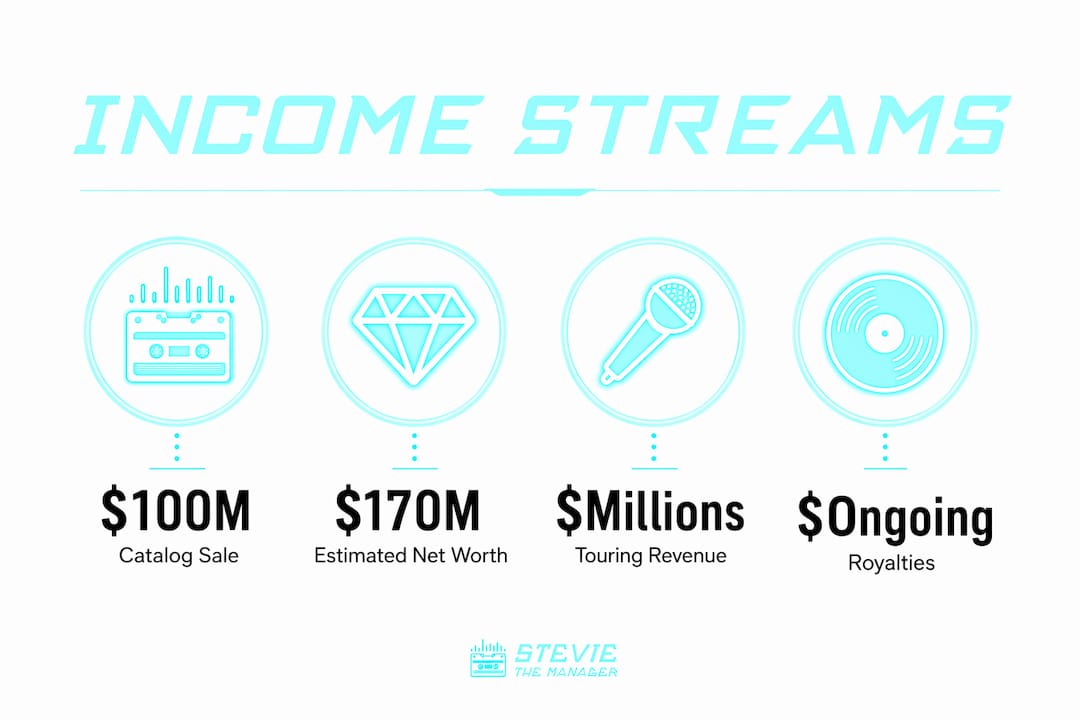
The financial logic behind catalog sales is worth understanding. A lump sum payment today is worth more than the same amount spread over 20 years of royalty payments. Big catalog deals transform continuous royalty income into a lump sum, acknowledging the time value of money for artists. Wayne’s decision to sell at that moment locked in a generational wealth transfer.
How does Lil Wayne’s wealth compare to other top rappers?
Lil Wayne consistently ranks among hip-hop’s wealthiest artists, but the gap between him and the very top of the list is significant. Recent financial rankings show his top-tier position, though artists like Jay-Z sit at a different level entirely due to equity stakes in companies like Armand de Brignac and Tidal.
| Artist | Estimated Net Worth | Primary Wealth Driver |
|---|---|---|
| Jay-Z | $2.5 billion | Business equity, catalog, spirits |
| Drake | $250 million | Music, OVO Sound, endorsements |
| Lil Wayne | $170 million | Catalog sale, royalties, Young Money |
| Nicki Minaj | $150 million | Music, endorsements, Fendi deal |
The table shows a clear pattern. Artists who own equity in businesses outside of music reach a different financial tier. Jay-Z’s wealth is driven by ownership stakes, not just royalties. Wayne’s fortune, by contrast, is built primarily on music rights and their monetization.
Catalog ownership is the dividing line between artists who earn well and artists who build lasting wealth. Wayne’s control of Young Money’s rights after the 2018 settlement gave him an asset that appreciated in value. Artists who sign away their masters early in their careers rarely recover that leverage.
- Owning your masters gives you control over licensing, sync deals, and future sales
- Label equity creates income that scales independently of personal output
- Endorsement deals add income but rarely build the kind of wealth that catalog ownership does
- Legal disputes over rights can freeze assets for years, delaying wealth accumulation
Why net worth figures for Lil Wayne vary across sources
Net worth estimates are not precise calculations. They are educated guesses based on publicly available information, and they vary widely depending on what each source includes or excludes. Forbes and industry commentary note these variations across estimates, and Wayne’s reported figures have ranged from $120 million to $170 million depending on the source and the year.

Taxes, legal fees, and undisclosed liabilities reduce the real number. A $100 million catalog sale sounds like a clean windfall, but capital gains taxes, legal costs from years of litigation, and management fees all take a share. Some trackers exclude liabilities and legal costs, while others estimate gross holdings, which explains the spread in published figures.
Wayne himself has publicly stated that he was broke at certain points in his career, particularly during his legal battles with Cash Money Records. Those statements were likely exaggerated for effect, but they point to a real truth. Cash flow and net worth are different things. An artist can hold valuable assets and still face short-term liquidity problems.
Pro Tip: When you read a celebrity net worth figure, check whether the source is estimating gross assets or net assets after liabilities. The difference can be tens of millions of dollars.
Lil Wayne’s assets beyond music: real estate, cannabis, and endorsements
Lil Wayne’s wealth extends well beyond music royalties. His diversified portfolio includes real estate, cannabis ventures, and brand endorsements that generate income independent of his recording career.
- Real estate: Wayne has owned high-value properties, including a home on Allison Island in Miami Beach. That property sold for a significant profit, adding to his liquid assets.
- Cannabis: Wayne launched his own cannabis brand, GKUA Ultra Premium, which taps into one of the fastest-growing consumer markets in North America. The brand sells flower, concentrates, and accessories.
- Brand endorsements: Beyond Mountain Dew and Beats by Dre, Wayne has partnered with companies across apparel and lifestyle categories, generating fees that compound over time.
- Young Money imprint: Even after the catalog sale, Wayne retains brand equity in the Young Money name and its cultural identity, which carries commercial value.
Diversification matters because music income is unpredictable. A rapper’s streaming numbers can drop sharply if a new generation moves on. Real estate and consumer brands generate income on different cycles, which protects overall financial stability. Wayne’s move into cannabis was particularly well-timed, as the industry expanded rapidly across multiple U.S. states during the early 2020s.
For fans who want to understand how hip-hop wealth is built over a career, Wayne’s portfolio is one of the clearest examples of what diversification looks like in practice.

Key Takeaways
Lil Wayne’s $170 million net worth is the product of catalog ownership, a landmark $100 million sale to Universal Music Group, and decades of diversified income across music, real estate, and brand deals.
| Point | Details |
|---|---|
| Net worth estimate | Forbes places Lil Wayne’s net worth at approximately $170 million as of early 2026. |
| Catalog sale impact | The 2020 sale of Young Money masters to Universal for over $100 million was the single largest wealth event in his career. |
| Legal settlements matter | The 2018 Cash Money settlement transferred full Young Money ownership to Wayne, enabling the 2020 deal. |
| Diversified income | Real estate, cannabis via GKUA, and brand endorsements generate income outside of music royalties. |
| Net worth figures vary | Different sources include or exclude liabilities, taxes, and undisclosed assets, causing estimates to range widely. |
Lil Wayne’s financial legacy: what it actually teaches
By Stephanos G

Most fans focus on the $170 million figure and stop there. That is the wrong place to stop. The more interesting story is how Wayne got there, and what it took to hold onto what he built.
The Cash Money dispute is the part of this story that deserves more attention. Wayne spent years in legal battles over ownership of his own recordings. During that period, his assets were effectively frozen. He could not sell, license, or fully monetize work he had created. That is a situation many independent artists face at a smaller scale, and it is genuinely damaging.
What changed everything was the 2018 settlement. Once Wayne controlled Young Money outright, the catalog became a sellable asset. The $100 million deal with Universal followed two years later. That sequence shows something important: rights disputes do not just cost legal fees. They delay the moment when an artist can actually convert their work into wealth.
The lesson I take from Wayne’s financial arc is that ownership is not just about pride. It is about timing. The artist who owns their catalog can choose when to sell, when to license, and when to hold. The artist who does not own their catalog has no choice at all. Wayne’s story is a case study in what happens when you fight for ownership and eventually win.
For independent artists watching from the outside, the richest rappers in hip-hop all share one trait: they controlled something beyond their own performance. Wayne is proof that even a long, painful legal fight is worth it if the asset on the other side is real.
— Stephanos G
Hip-hop wealth and what it means for artists building today
Lil Wayne’s financial story is one of the most instructive in the music industry, and it connects directly to the broader culture that Lit Nightz News covers every week.

At Lit Nightz News, we break down how hip-hop’s cultural and economic impact shapes the careers of artists at every level, from global superstars to independent acts building from the ground up. Wayne’s path from Cash Money disputes to a nine-figure catalog sale shows what is possible when artists understand the business behind the music. Whether you are a fan trying to understand how wealth works in rap, or an artist figuring out your own next move, the principles are the same. Ownership, diversification, and patience are what separate artists who earn from artists who build. Explore more at Lit Nightz News and stay connected to the stories that matter in hip-hop.
FAQ
What is Lil Wayne’s net worth in 2026?
Forbes estimates Lil Wayne’s net worth at approximately $170 million as of early 2026. His musician earnings are listed separately at $27 million.

How did the Young Money catalog sale affect his wealth?
Lil Wayne sold the Young Money catalog to Universal Music Group in 2020 for more than $100 million. That single transaction converted years of royalty rights into immediate cash, significantly boosting his net worth.
Why do different sources report different net worth figures for Lil Wayne?
Net worth estimates vary because some sources count gross assets while others subtract taxes, legal fees, and liabilities. Forbes and industry trackers acknowledge these differences, which is why figures range from $120 million to $170 million depending on the source.
Does Lil Wayne earn income outside of music?
Yes. His income sources include real estate sales, the GKUA Ultra Premium cannabis brand, and brand endorsements with companies like Mountain Dew and Beats by Dre. These ventures generate income independent of his recording catalog.
How does Lil Wayne’s wealth compare to other rappers?
Wayne ranks among hip-hop’s wealthiest artists, but artists like Jay-Z, whose net worth exceeds $2.5 billion, have built larger fortunes through business equity outside of music. Wayne’s wealth is primarily driven by catalog ownership and its monetization.
Recommended
- Lil Wayne Net Worth 2025: The Real Story Behind His $170M Empire – Stevie The Manager aka Stangr The Man
- Rapper Eminem Net Worth 2025: The Untold Story Behind His $250M Empire – Stevie The Manager aka Stangr The Man
- Richest Rappers in the World: 2026 Rankings
- Jay Z Net Worth 2025: From Brooklyn Streets to Billion-Dollar Empire – Stevie The Manager aka Stangr The Man


No Comments