


The Role of Vulnerability in Rap: Lyrics and Mental Health
Vulnerability in rap is defined as the honest expression of personal pain, fear, trauma, and emotional struggle through lyrics. The role of vulnerability in rap goes far beyond confessional writing. It shapes how artists build credibility, how fans find connection, and how hip-hop has evolved into one of the most emotionally complex genres in music history. Research confirms that hip-hop aids emotional coping for a significant share of young listeners, and linguistic studies show rap’s vocabulary depth surpasses most other popular genres. Understanding why emotional honesty matters in rap means understanding what makes the genre resonate at its core.
How does vulnerability manifest in rap lyrics and impact storytelling?
Vulnerability in rap lyrics shows up through specificity. The most affecting verses name real places, real people, and real feelings rather than hiding behind metaphor or bravado. That specificity is what separates a memorable verse from a forgettable one.
Rap’s capacity for emotional depth is backed by language data. Rap’s lexical diversity scores a TTR (type-token ratio) of 0.5070, higher than pop and rock. That means rap artists use a wider range of unique words per song, giving them more tools to articulate complex emotional states.
The emo rap movement made vulnerability commercially undeniable. Emo rap emerged commercially in 2017 when Lil Uzi Vert’s “XO Tour Llif3” hit the Billboard Hot 100, bringing themes of depression and heartbreak into mainstream conversation. That track proved listeners were not just tolerating emotional honesty in rap. They were actively seeking it.
Storytelling techniques that carry vulnerability effectively include:
- First-person confession: Placing the artist directly inside the experience rather than narrating from a distance
- Temporal specificity: Naming exact ages, dates, or events to ground abstract pain in real memory
- Unresolved endings: Leaving a story without a clean conclusion, which mirrors how real trauma actually feels
- Contrast and juxtaposition: Placing moments of joy directly beside grief to show emotional complexity
These techniques appear across rap’s most captivating narratives, from underground projects to platinum albums. The best rap storytellers do not explain their emotions. They recreate the moment and let the listener feel it.
Pro Tip: If you want to understand how vulnerability works in rap lyricism, study the verses where an artist’s voice changes in pitch or pace. That shift almost always marks the emotional center of the song.

What mental health themes are communicated through vulnerability in rap?
Rap has functioned as a therapeutic confessional space since its earliest days. Hip-hop has historically countered the stigma around emotional expression in Black communities, from Grandmaster Flash’s “The Message” to Kendrick Lamar’s “u.” That tradition is not nostalgia. It is an active, living function of the genre.
The mental health themes most commonly expressed through vulnerable rap lyrics include depression, anxiety, addiction, grief, and trauma from violence or poverty. These are not abstract topics in rap. They are drawn from lived experience and delivered with the kind of detail that clinical language rarely captures.
Hip-hop aids emotional coping for 72.2% of undergraduate respondents in a survey of 54 students, who reported that hip-hop helps them manage emotional difficulties. That figure reflects something fans already know intuitively. When an artist names a feeling you have been carrying alone, the weight shifts.
Hip-hop pedagogy also aids marginalized populations in developing emotional awareness and coping skills. Educators and therapists have built entire programs around rap’s ability to help people process experiences they cannot otherwise articulate. The genre does not just reflect mental health struggles. It actively helps people work through them.
The table below maps the most common mental health themes in rap to their cultural function:
| Mental health theme | How rap addresses it |
|---|---|
| Depression | First-person narratives that normalize low emotional states |
| Anxiety | Lyrical urgency and fragmented flow that mirrors anxious thought |
| Trauma | Detailed storytelling that processes past events publicly |
| Addiction | Honest accounts of substance use without glorification or shame |
| Grief | Tribute tracks and raw emotional processing after loss |
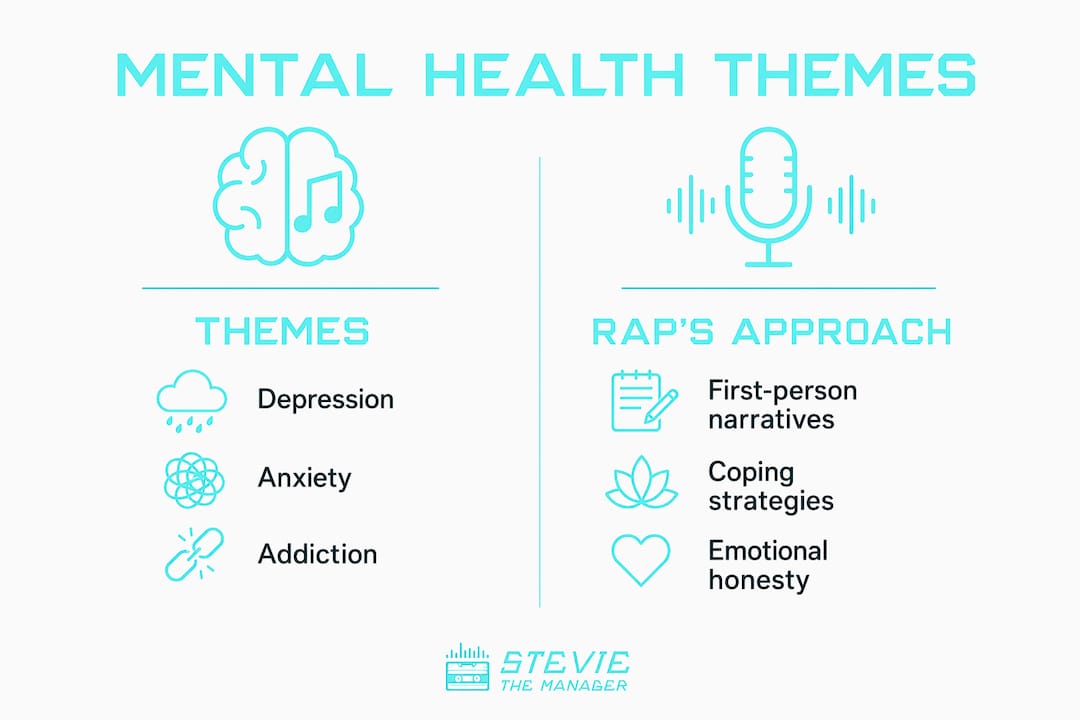
Rap’s willingness to address mental health in hip-hop without sanitizing it is one reason the genre holds such loyalty among fans who feel unseen by other forms of media.
How does the streaming era affect the authenticity of vulnerability in rap?
The streaming era creates a specific tension for emotional expression in rap. Platforms reward songs that hook listeners within the first 30 seconds, which pushes artists to front-load emotional signals. Performed sincerity in the streaming era pressures artists to package vulnerability as a product rather than express it as a truth.
This distinction matters. Front-loading vulnerability can create the perception of optimized emotion rather than genuine feeling. Specificity and ambiguity, the qualities that make real vulnerability feel real, often get sacrificed for immediate impact. The result is music that sounds emotionally honest but feels hollow on repeated listening.
Fans detect the difference faster than most artists expect. Fans increasingly reject performative vulnerability when it feels calculated. Industry coach Stevie Red McMinn advises artists to share only what they genuinely feel, because forced openness reads as manipulation rather than connection.
The contrast between genuine and performed vulnerability breaks down like this:
| Authentic vulnerability | Performed vulnerability |
|---|---|
| Rooted in specific personal experience | Relies on generic emotional tropes |
| Feels consistent across an artist’s catalog | Appears only when commercially convenient |
| Includes ambiguity and unresolved emotion | Delivers clean emotional arcs for easy consumption |
| Builds long-term fan trust | Generates short-term streams but erodes credibility |
The role of authenticity in songwriting applies directly to rap. Artists who maintain a genuine voice across albums, even when that voice is uncomfortable or commercially risky, build the kind of catalog that lasts beyond a single viral moment.
Pro Tip: When evaluating whether a rap artist’s vulnerability is genuine, listen to their deep cuts and B-sides. Authentic emotional expression shows up consistently, not just on singles.
Why is vulnerability critical for artist-fan connection and cultural impact?
Vulnerability is the mechanism through which rap builds community. When an artist admits to struggling with something a fan has never heard named publicly, that fan stops being a passive listener. They become part of a shared experience. That shift is the foundation of hip-hop’s cultural identity and connection.
Audiences respond more to emotional truth than to technical perfection. Voice expert Jennifer May identifies authentic emotion as the primary driver of connection in performance. A technically flawless verse delivered without genuine feeling moves no one. A rough verse delivered with real pain moves everyone.
The cultural impact of vulnerability in rap extends well beyond individual songs. Hip-hop has used emotional honesty to challenge the stigma around men expressing pain, to document the psychological cost of systemic inequality, and to give voice to communities whose experiences rarely appear in mainstream media. That is not a side effect of vulnerability in rap. It is the point.
The reasons vulnerability strengthens rap’s cultural reach include:
- Stigma reduction: Public disclosure of mental health struggles by artists normalizes those conversations for fans
- Cross-demographic reach: Emotional honesty translates across cultural and generational lines in ways that style-specific trends do not
- Social commentary: Vulnerable lyrics about poverty, violence, and discrimination carry more weight than abstract political statements
- Long-term relevance: Albums built on genuine emotional truth age better than albums built on trends
Emotional expression in rap functions best when it evolves from narrating pain to achieving emotional wisdom. The artists who sustain long careers are those who grow through their vulnerability rather than repeating the same wound on every project.
Key Takeaways
Vulnerability in rap is the defining force behind the genre’s emotional depth, mental health impact, and lasting cultural relevance.
| Point | Details |
|---|---|
| Lyrical specificity drives connection | Naming real experiences with precise detail separates authentic rap from generic emotional content. |
| Rap supports mental health | Research shows hip-hop helps a majority of young listeners cope with emotional difficulties. |
| Streaming pressures authenticity | Platform incentives push artists toward performed sincerity, which fans detect and reject over time. |
| Vulnerability builds community | Honest emotional expression turns passive listeners into loyal fans with a shared sense of identity. |
| Emotional growth sustains careers | Artists who evolve from narrating pain to expressing wisdom build catalogs that outlast trends. |
Vulnerability in rap: what I actually think
The conversation around vulnerability in rap often gets flattened into a binary. Either an artist is “keeping it real” or they are selling emotion for streams. The truth is more complicated, and more interesting.
What I have observed is that the most powerful vulnerable rap does not come from artists who decided to be vulnerable. It comes from artists who had no other choice. The specificity in a Kendrick Lamar verse about his own failures, or an underground artist rapping about a parent’s addiction, does not feel calculated because it is not. It is the only honest way to say what needs to be said.
The danger I see in the current era is not that artists are being too vulnerable. It is that the commercial reward for performing vulnerability has made it harder to recognize the real thing. When every album rollout includes a mental health disclosure, the disclosure loses weight. That does not mean artists should stop being honest. It means fans need to listen more carefully, and artists need to protect the parts of themselves they share.
Vulnerability is also a form of resilience. Saying “this happened to me and I survived it” in front of millions of people is not weakness. It is one of the toughest things a person can do. The artists who understand that distinction are the ones worth paying attention to.
— Stephanos G
Lit Nightz Records and the artists who keep it real
Independent rap is where the most unfiltered vulnerability lives. Major label pressures and commercial formatting rarely leave room for the kind of raw, specific storytelling that defines the best vulnerable rap. Independent artists build on their own terms, which means their emotional expression does not have to pass through a committee.

Lit Nightz Records exists to support exactly that kind of artist. The label, part of the StangrTheMan.com platform, focuses on emerging hip-hop artists who lead with authenticity and genuine personal stories. If you want to understand why independent hip-hop continues to grow while major label rap cycles through trends, the answer starts with vulnerability. Real stories told by real artists, without compromise, are what fans keep coming back for.
FAQ
What is the role of vulnerability in rap music?
Vulnerability in rap is the honest expression of personal pain, trauma, and emotional struggle through lyrics. It drives authentic storytelling, deepens artist-fan connection, and gives the genre its lasting cultural weight.
How does vulnerability in rap affect mental health?
Research shows that hip-hop supports emotional coping for the majority of young listeners surveyed, helping them process difficult feelings they may not be able to articulate otherwise.
What is the difference between authentic and performative vulnerability in rap?
Authentic vulnerability is rooted in specific personal experience and remains consistent across an artist’s work. Performative vulnerability relies on emotional tropes timed to commercial releases and erodes fan trust over time.
Why did emo rap become commercially successful?
Emo rap broke through commercially in 2017 when tracks like Lil Uzi Vert’s “XO Tour Llif3” brought depression and anxiety themes to the Billboard Hot 100, proving mainstream audiences actively wanted emotional honesty in rap.
How does rap lyricism support emotional expression compared to other genres?
Rap’s lexical diversity score of 0.5070 exceeds pop and rock, giving artists a wider vocabulary to articulate complex emotional states with precision and depth.
Recommended
- What Is Resilience in Rap: Culture, Mind, and Music
- The Psychology of Rap: Unraveling the Connection Between Beats, Lyrics, and the Human Mind – Stevie The Manager aka Stangr The Man
- Hidden Life Lessons: What Classic Hip Hop Taught Me About Success – Stevie The Manager aka Stangr The Man
- Why Mental Health Matters in Hip-Hop: Healing Through Rap





No Comments